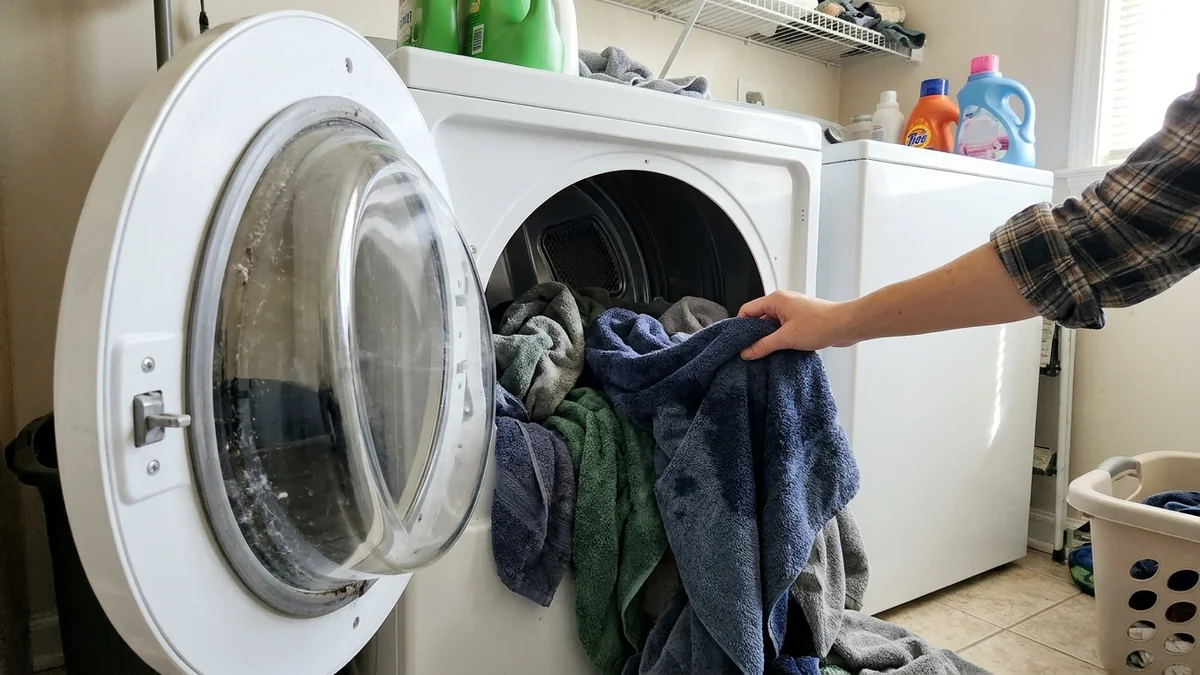
A dryer not heating usually still tumbles, buzzes and runs the full timer, and then hands you a load of warm, wet laundry. That pattern is good news: the motor and controls are working, so the problem sits somewhere in a short chain of heat parts or in the airflow. Here is how to narrow it down in the order a repair tech would, starting with the free checks.
A dryer that runs but does not heat is most often caused by a clogged lint screen or vent, one tripped half of a double breaker (electric dryers), a closed gas valve (gas dryers), or a blown thermal fuse. Clean the lint screen and vent first, check the breaker or gas supply, then test the thermal fuse, heating element or igniter if it still blows cold air.
Start here: three checks that fix a lot of “no heat” calls
↑ ContentsPick a heat cycle
It sounds obvious, but “Air Fluff”, “Air Dry” and some delicate or “Wrinkle Release” settings use little or no heat. Run a normal timed cycle on high heat with a few damp towels before you go any further.
Clean the lint screen and look at the vent
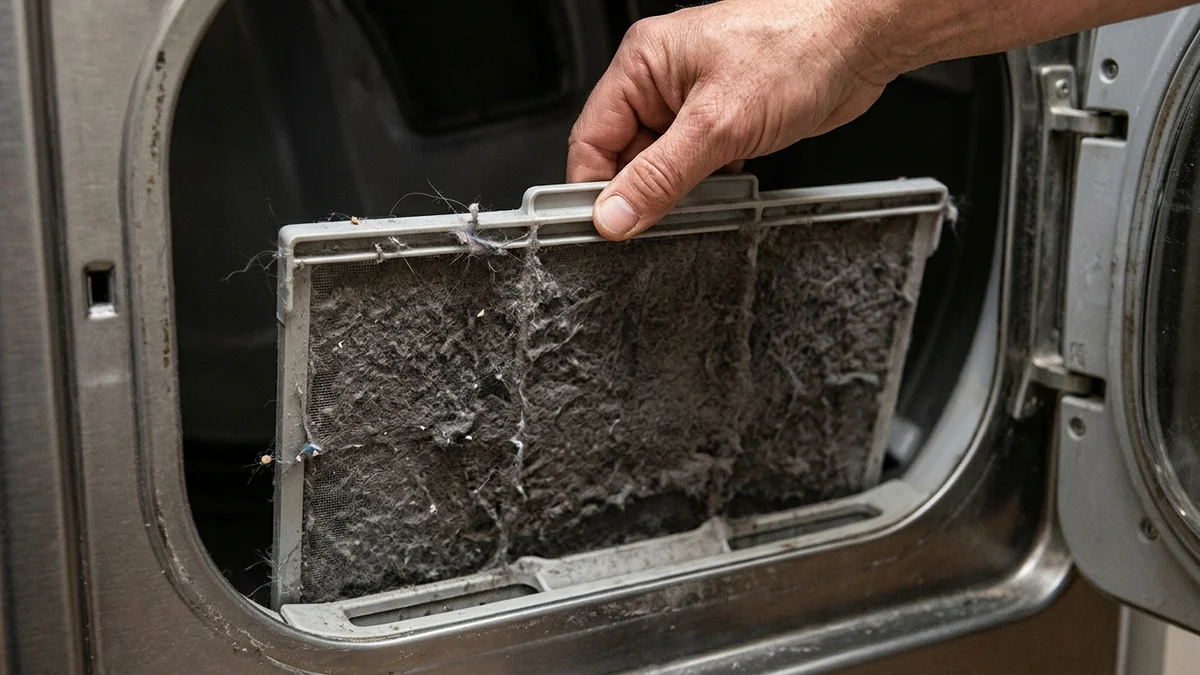
Pull the lint screen, clear it, and hold it up to a light. If dryer sheets have left a waxy film, wash it with warm soapy water and let it dry. Then go outside while the dryer runs: you should feel a strong, warm stream of air at the vent hood. Weak or no airflow means the vent is restricted, and many dryers cut the heat when they sense overheating.
Check the power or gas supply
Electric dryers use a 240-volt double breaker. If one half trips, the drum can still turn on 120 volts while the heating element gets nothing. Switch the dryer’s breaker fully off, then back on. On a gas dryer, make sure the shutoff valve behind the machine is open (handle in line with the pipe) and that other gas appliances are working.
Why a blocked vent is the usual root cause
↑ ContentsMost heat parts do not fail out of nowhere. When lint builds up in the vent, hot air cannot escape, the drum overheats and a safety part opens the heat circuit. Fix the part without fixing the vent and the new part often fails within weeks.
It is also a safety issue. The U.S. Fire Administration found that “failure to clean” is the leading factor in residential clothes dryer fires, and lint is among the items most often ignited. Clean the vent at least once a year, and sooner if loads start taking longer to dry.
- Disconnect the dryer and pull it out from the wall carefully.
- Remove the duct and clear it with a vent brush kit, working from both ends.
- Replace crushed plastic or foil ducting with rigid or semi-rigid metal duct.
- Check the exterior hood: the flaps should open freely, with no nest, lint plug or screen clogged with fuzz.
Electric dryer not heating: the parts to test
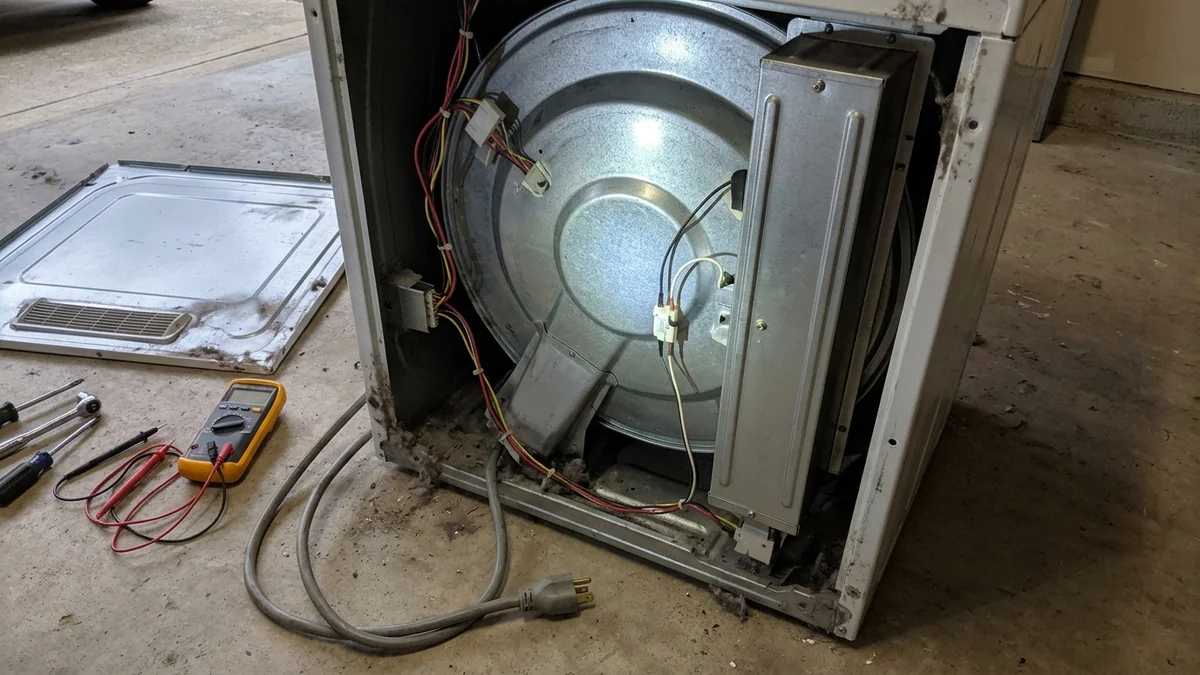
↑ ContentsAn electric dryer’s heat circuit runs through several parts in a row. If any one of them opens, you get no heat. You need a multimeter and the wiring diagram, which is usually taped inside the back or front panel. Unplug the dryer before you open anything.
| Part | What it does | Typical sign it failed |
|---|---|---|
| Thermal fuse | One-time safety cutoff for overheating | No continuity; often follows a clogged vent |
| Heating element | Coil that makes the heat | Visible break in the coil, or no continuity |
| High-limit thermostat | Cuts heat if the housing gets too hot | No continuity at room temperature |
| Cycling thermostat | Turns heat on and off to hold temperature | No continuity, or clothes overheat then go cold |
| Timer or control board | Sends power to the heat circuit | All parts test good but there is still no heat |
Test the cheap, common parts first: thermal fuse, then heating element, then thermostats. If the thermal fuse has blown, replace it and clean the vent before running the dryer again. Never bypass a thermal fuse with a jumper wire, even “just to test.”
Gas dryer not heating: igniter, sensor and coils
↑ ContentsOn a gas dryer, look through the small inspection hole near the burner while the dryer starts a heat cycle. What you see points to the part.
- Igniter does not glow: the igniter, thermal fuse or flame sensor is likely at fault.
- Igniter glows, then goes out with no flame: the gas valve coils are the classic culprit. They often fail once the dryer warms up, which is why some gas dryers heat for the first few minutes and then stop.
- Flame lights, then shuts off quickly: check airflow and the cycling thermostat.
Symptom guide
↑ Contents| What happens | Most likely cause |
|---|---|
| Runs, no heat at all, vent was never cleaned | Blown thermal fuse from overheating |
| Runs, no heat, electric dryer, panel breaker looks fine | One half of the double breaker tripped |
| Heats a little, loads take two cycles | Restricted vent or weak element |
| Gas dryer heats, then goes cold mid-cycle | Gas valve coils |
| Will not start at all | Door switch, start switch or main fuse, not a heat part |
When to call a technician
↑ Contents- You smell burning, see scorch marks or the dryer trips the breaker repeatedly.
- All heat parts test good and the problem is the timer or control board.
- It is a gas dryer and the fault is in the valve, burner or gas line.
- The vent runs a long way through walls or the roof and you cannot clean all of it.
Another appliance acting up in the same laundry area? A tripped GFCI is a common reason nearby outlets go dead; our guide to a GFCI that won’t reset covers it.
Dryer not heating: FAQ
↑ ContentsIs there a reset button for a dryer that won’t heat?
Some brands have a manual-reset high-limit or motor overload, but most thermal fuses are one-time parts. If the dryer has a reset button, check the manual for its location. If not, the part must be replaced.
Why does my dryer heat sometimes but not always?
On gas dryers, failing valve coils are the usual reason. On electric dryers, a weak element or a cycling thermostat can cause the same on-and-off behavior.
Can a clogged vent stop a dryer from heating?
Yes. It can trip the high-limit thermostat or blow the thermal fuse, both of which cut the heat. Clean the vent before replacing any heat part.
How long should a normal load take to dry?
For most full-size dryers, a mixed load usually takes under an hour. Loads that need a second cycle are a strong hint that airflow is restricted.
Is it worth fixing an old dryer that won’t heat?
Usually, yes. Thermal fuses, elements and igniters are inexpensive parts. Replacement makes more sense when the drum, motor or control board has also failed.
Sources: U.S. Fire Administration, Clothes Dryer Fires in Residential Buildings.
When your dryer is not heating, clean the lint screen and vent, check the breaker or gas valve, and only then test the thermal fuse, element or igniter. Clearing the airflow fixes the cause, not just the symptom.