Frozen pipes announce themselves in a very ordinary way: you turn on the kitchen faucet on a bitter January morning and get a thin trickle, or nothing at all. Thaw it slowly and correctly, and you can often avoid the split pipe and flooded floor that follow a careless fix. This guide covers how to confirm a pipe is frozen, find the frozen section, thaw it safely, handle a burst pipe, and set up your house so it does not happen again next winter.
To thaw a frozen pipe, open the faucet it feeds, then warm the frozen section with a hair dryer, an electric heating pad or hot towels, working from the faucet back toward the ice. Keep heating until full pressure returns. Never use a torch or any open flame. If a pipe bursts, shut off the main water valve first, then call a plumber.
Why pipes freeze and which ones are at risk↑ Contents
Water expands when it turns to ice. Inside a closed pipe, that expansion has nowhere to go, and pressure builds between the ice plug and the closed faucet. The American Red Cross points out that this pressure can split pipes made of metal or plastic, no matter how strong they are. That is why the break often shows up a few feet from the ice.
Pipes in the warm middle of the house rarely freeze. The trouble spots are predictable:
- Outdoor hose bibs, sprinkler lines and pool supply lines.
- Supply lines in unheated spaces: crawl spaces, attics, garages and unfinished basements.
- Pipes inside exterior walls with thin or missing insulation, especially on the north side of the house.
- Pipes under kitchen and bathroom sinks set against an outside wall, where closed cabinet doors keep room heat away.
- The main water line where it enters through the foundation.
Signs a pipe is frozen↑ Contents
The most reliable sign is simple: a faucet that should run strong gives you only a trickle, or nothing.
- No water, or a weak trickle, from one or more faucetsThe classic sign. If only the hot side or only one fixture is affected, the frozen section is on that branch line, not the main.
- Frost or ice on the outside of an exposed pipeCommon in crawl spaces and under sinks. Visible frost tells you exactly where to start warming.
- A toilet that does not refill after flushingThe supply line to that toilet, or the branch feeding that bathroom, has likely frozen.
- A pipe that looks swollen, bulged or crackedStop and treat it as a probable burst pipe. Shut off the main water before you thaw anything, because the leak starts when the ice melts.
- Water stains or dampness on a wall or ceilingThat one means a pipe may have already split and is leaking slowly. Go straight to the burst pipe section below.
How to find the frozen section↑ Contents
Before you warm anything, narrow down where the ice is.
- Test every faucet in the house, hot and cold, upstairs and down. The Red Cross advises this because one frozen pipe often means others are frozen too.
- If nothing works anywhere, the freeze is probably on the main line near where it enters the house, or in the line from the meter. Look at the foundation wall, the crawl space entry and the meter pit lid.
- If one fixture is dry, follow its supply line back from the faucet toward the wall. Start with the stretches running along exterior walls, under cabinets or through unheated rooms.
- Feel the pipe with your hand. The frozen stretch is noticeably colder than the rest, and you may see frost on it.
If the frozen section is buried inside a finished wall or ceiling, you will not reach it directly. Raising the room temperature and opening nearby cabinet doors may still work, and a plumber is the next step if it does not.
How to thaw frozen pipes safely↑ Contents
Thawing is slow work. A pipe warmed gently over 30 minutes to an hour is far less likely to crack than one hit with intense heat, and the methods below are the ones recommended by the Red Cross and by Iowa State University Extension.
Never use an open flame. No propane torch, blowtorch, kerosene or propane heater, or charcoal stove. A torch can ignite wood framing and insulation inside the wall, and overheating a pipe can make it fail.
Electricity and water: keep hair dryers and heaters away from standing water, and do not stand in water while using one. If the pipe looks cracked, shut off the main water valve before you start, since the leak begins when the ice melts.
-
Open the faucet the pipe feeds
Turn on both the hot and cold handles of the affected faucet. An open faucet relieves pressure as the ice melts, and the flowing water helps clear the rest of the blockage.
-
Start warming near the faucet and work back
Apply heat at the faucet end first, then move slowly toward the frozen section. That way, melted water always has an open path out, and you are not building pressure behind a plug of ice that has not thawed yet.
-
Use a hair dryer or heat gun on low
A regular hair dryer is the most practical tool for exposed pipes under sinks and in basements. Keep it moving along the pipe, a few inches away, rather than aiming it at one spot. A heat gun works too, but only on its lowest setting and with extra care around PVC and PEX, which soften at much lower temperatures than copper.
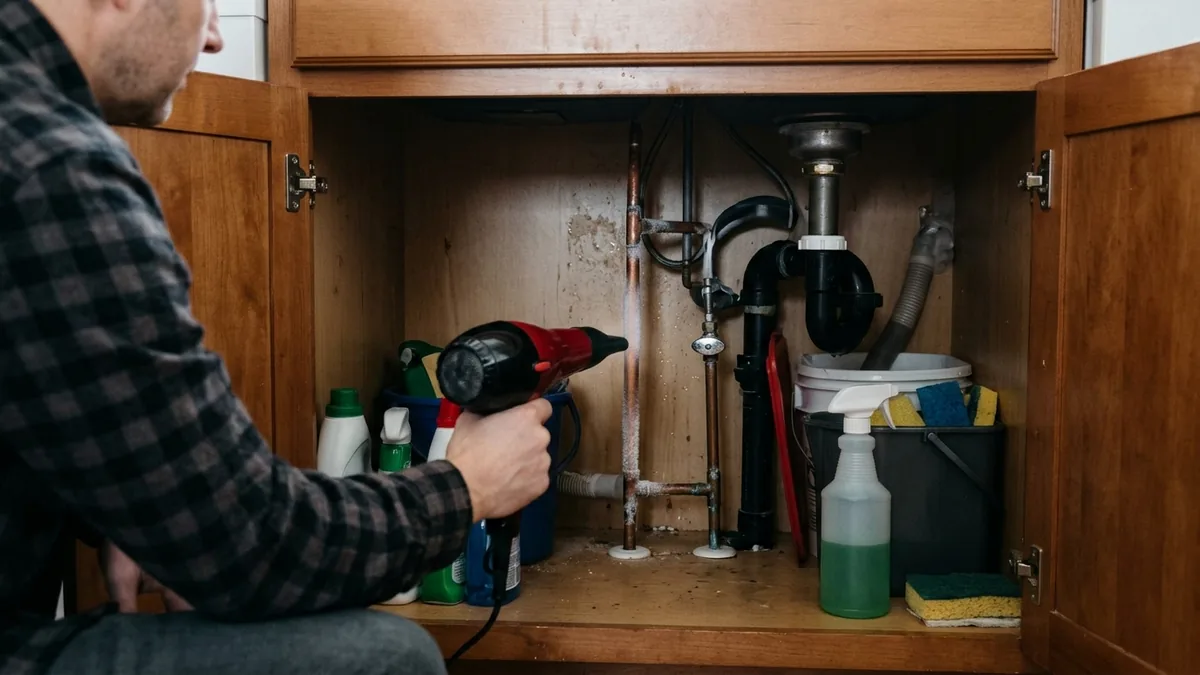
Warm the pipe with a hair dryer, starting near the open faucet and working back. -
Wrap the pipe with a heating pad or hot towels
An electric heating pad wrapped around the pipe gives steady, hands-off heat. Towels soaked in hot water work as well: wrap them around the frozen section and swap them out as they cool.
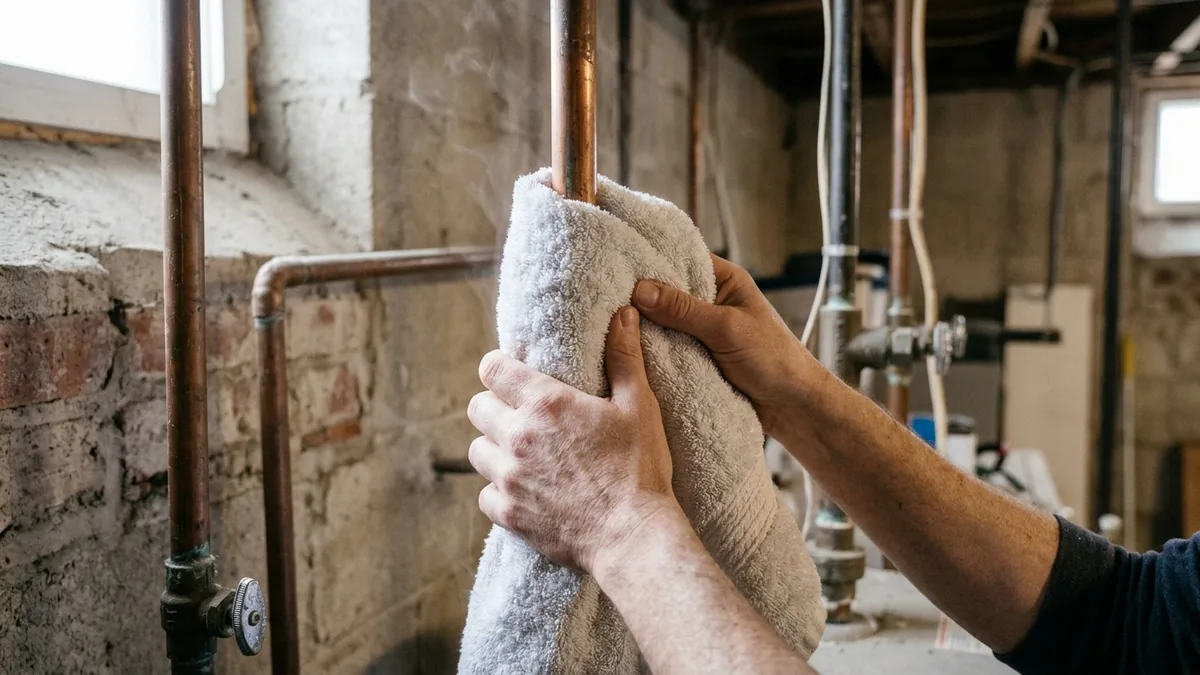
Hot towels wrapped around an exposed pipe thaw it slowly and safely. -
Warm the room with a space heater
For a pipe inside a cabinet, a cold wall or a small utility room, a portable electric space heater can raise the air temperature around it. Keep the heater at least 3 feet from anything that can burn, choose one with tip-over and overheat shutoff, and plug it directly into a wall outlet, not an extension cord. Never leave it running unattended or overnight.
-
Keep going until full pressure returns
Do not stop at the first trickle. Keep heating until the faucet runs at normal pressure, then check every other fixture in the house again. Once everything flows, look along the pipe you thawed for drips or wet spots, and check again an hour later.
Electrical heat tape and heat cable are for prevention, installed ahead of time following the manufacturer’s instructions. They are not an emergency thawing tool to wrap around a frozen pipe in a hurry.
The Indiana Office of Utility Consumer Counselor adds one useful rule for after the thaw: if you shut the main valve, turn the water back on very slowly and watch for leaks, ready to close it again.
What to do if a pipe bursts↑ Contents
A burst pipe can push out a lot of water fast, and often you do not see it until the ice melts. Learn where your main shutoff is before winter, not during the flood.
-
Shut off the main water valve
The main shutoff is usually where the water line enters the house: in the basement on the front wall, in a crawl space, near the water heater, or in a utility closet. On a round wheel handle, turn clockwise. On a lever handle, turn it a quarter turn so it sits across the pipe. If you cannot find or close it, the water utility can shut the curb valve at the street.
-
Stay clear of water near electricity
If water is near outlets, a panel, appliances or extension cords, do not walk through it. Turn off power to the affected area at the breaker panel only if you can reach the panel while standing on a dry floor. Otherwise, call the utility or an electrician. Water dripping through a ceiling light fixture is a reason to kill that circuit right away.
-
Drain the lines and limit the damage
Open the faucets on the lowest level of the house to drain the water still in the pipes. Move furniture, rugs and electronics out of the wet area, and start mopping and running fans.
-
Call a licensed plumber
A split pipe needs a proper repair. Push-on fittings and repair clamps from the hardware store can hold as a temporary fix on an exposed pipe, but have a plumber check the line and look for other weak spots before you rely on it.
-
Document everything for your insurance
Take photos and video of the burst pipe, the water, and every damaged item before you throw anything away. Then call your insurer. The Maryland Insurance Administration explains that homeowners policies may cover a sudden and accidental discharge from a burst frozen pipe, but coverage can be denied if the insurer finds the home was neglected, for example by not keeping it heated or not shutting off the water in a vacant house.
How to prevent frozen pipes: winter checklist↑ Contents
Prevention costs very little next to a repair and a water damage claim.
Before the first freeze
- Disconnect and drain garden hoses. Close the indoor valve that feeds each outdoor hose bib, then open the outdoor bib so trapped water can drain, as the Red Cross recommends.
- Drain sprinkler and pool supply lines following the installer’s instructions. Do not add antifreeze unless directed to.
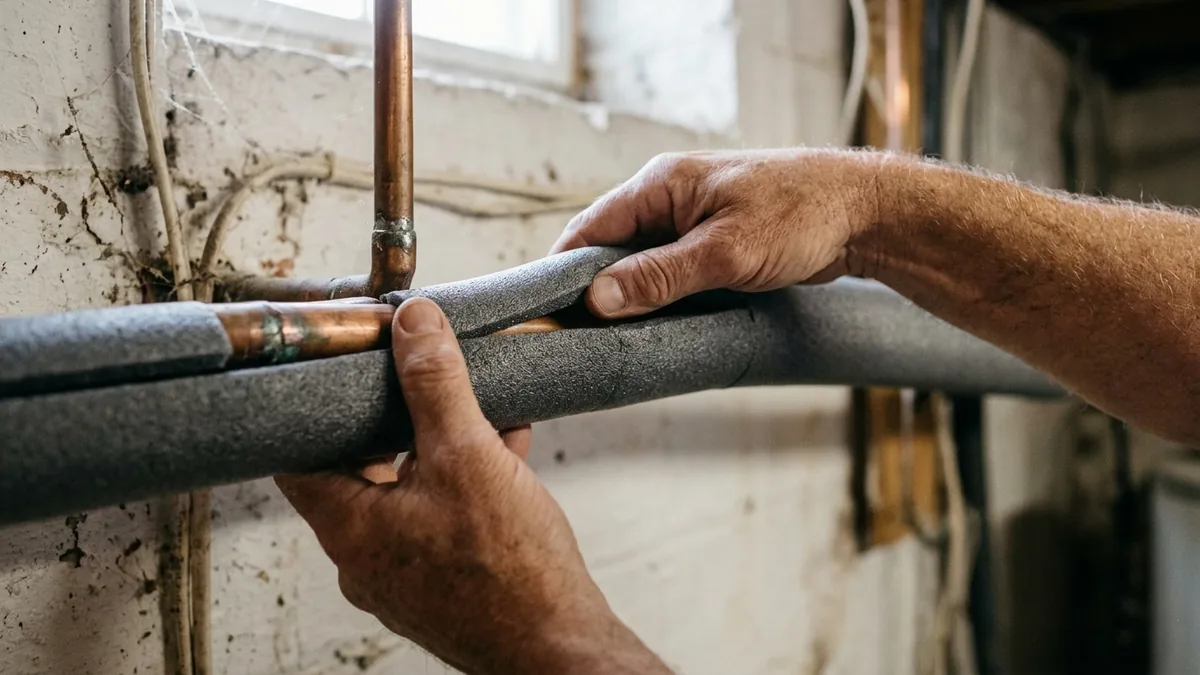
- Insulate exposed pipes in crawl spaces, attics, garages and under sinks with foam pipe sleeves. Insulate both hot and cold lines.
- Consider UL-listed heat tape or heat cable on pipes that freeze every year, installed exactly per the manufacturer’s instructions.
- Seal gaps where cold air reaches pipes: caulk around penetrations in exterior walls, weatherstrip doors and windows, repair broken basement windows and close or cover crawl space vents for the winter.
- Find and test your main shutoff valve.
During cold snaps
- Let faucets drip. Run a thin trickle of cold water from faucets fed by exposed pipes, ideally on an exterior wall. In a two-story house, the Indiana OUCC suggests a second trickle from an upstairs faucet when temperatures drop to 0°F or below.
- Open cabinet doors under kitchen and bathroom sinks so warm room air reaches the plumbing. Move cleaners and chemicals out of children’s reach first.
- Keep the thermostat steady day and night. The Red Cross notes a slightly higher heating bill beats a burst pipe repair.
When you travel
- Keep the heat at 55°F or higher. Both the Red Cross and FORTIFIED, the home program of the Insurance Institute for Business & Home Safety (IBHS), use 55°F as the minimum.
- Add a temperature alert. IBHS suggests a monitoring system that warns you when the indoor temperature falls below 55°F, so a furnace failure does not go unnoticed for days.
- Ask a neighbor to check the house on the coldest days.
- For a long absence or a vacant house, shut off the main water and drain the lines. As noted above, insurers look closely at vacant homes.
Power outage in a deep freeze? Without heat, a house can drop below freezing within a day. If the outage looks long, shut off the main water and open faucets to drain the lines. Never bring a generator, grill or camp stove indoors to keep the house warm.
When to call a plumber↑ Contents
Call a licensed plumber in any of these cases:
- You cannot find the frozen section, or it sits inside a finished wall, ceiling or floor.
- Nothing flows anywhere in the house and the main line or meter appears frozen.
- A pipe is bulged, cracked or leaking, or you see water stains spreading.
- You have warmed the pipe for an hour or more with no improvement.
- The same pipe freezes every winter. That usually means it needs to be insulated, rerouted or protected with heat cable.
Frozen pipes: FAQ↑ Contents
At what temperature do pipes freeze?
Water freezes at 32°F, but pipes inside a heated house usually need a longer, harder cold spell before they freeze. Exposed pipes in crawl spaces, attics, garages and exterior walls are at risk whenever the outdoor temperature stays well below freezing for several hours, especially overnight and in wind.
Will frozen pipes thaw on their own?
They often do once the weather warms, but waiting is risky. Pressure keeps building while the ice sits there, and you may not notice a split until the thaw floods the room. Opening the faucet and warming the pipe gently is safer than leaving it.
How long does it take to thaw a frozen pipe?
An exposed pipe warmed with a hair dryer or heating pad often clears in 30 minutes to an hour. A pipe inside a wall, or a main line, can take several hours of raising the room temperature, and some need a plumber’s equipment.
Should I turn off the water if my pipes are frozen?
If you see a crack, a bulge or any leak, yes: shut the main valve before thawing. If the pipe looks intact, leave the main open and the faucet open so water can flow out as the ice melts, and keep the shutoff within reach.
Does dripping faucets really prevent frozen pipes?
Yes. Moving water is harder to freeze, and an open faucet relieves the pressure that splits pipes. The Red Cross recommends a trickle of cold water from faucets fed by exposed pipes during very cold weather.
Does homeowners insurance cover a burst pipe?
Often, when the burst is sudden and accidental and you took reasonable care to keep the house heated. Damage tied to neglect, such as an unheated vacant home with the water left on, may be denied. Check your policy and deductible before winter.
Frozen pipes are a fixable winter problem when you act early: open the faucet, warm the pipe gently from the faucet end, and never bring a flame near it. If a pipe bursts, close the main valve first and call a plumber. Then spend an afternoon on insulation, sealed gaps and drained hoses, and keep the heat at 55°F or more whenever you leave.
Sources: American Red Cross, Preventing and Thawing Frozen Pipes, FORTIFIED (IBHS), Defend Against Frozen Pipes, Indiana OUCC, Preventing Frozen Pipes, Maryland Insurance Administration, Protect Your Pipes.