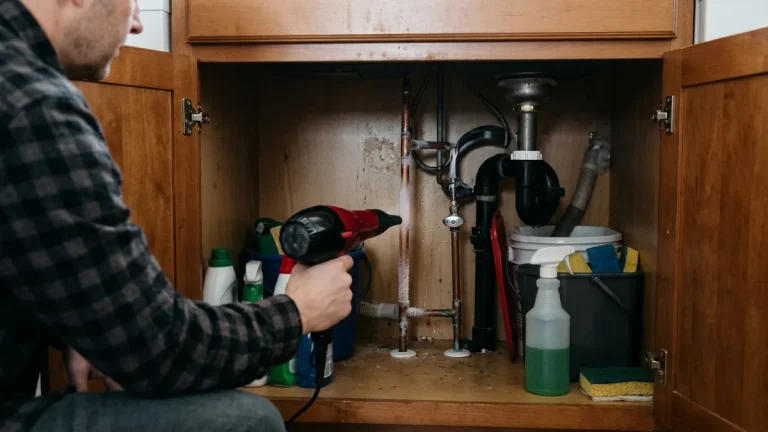
Low water pressure is one of those problems that sounds like a big plumbing job and usually is not. Usually the cause is a scaled showerhead, a gritty aerator, or a valve somebody closed halfway years ago. Figure out where the pressure is low before you touch anything, because a weak shower and a weak whole house have different fixes.
First find the scope: one fixture, hot water only, the whole house, or the whole street. One fixture usually means a clogged aerator or showerhead, so soak it in white vinegar. Whole house points to a partly closed main valve, a failing pressure reducing valve, a clogged filter or old galvanized pipes. Hot side only points to the water heater. A whole street means calling the water utility.
Start here: where is the pressure low?↑ Contents
Walk the house before you buy a single part. Open the cold tap at every sink and tub, then the hot tap, and an outdoor spigot. The pattern of weak and strong taps tells you almost everything.
- One fixture only, both hot and coldThe problem lives in that fixture: a clogged aerator, a scaled showerhead, a flow restrictor, a dirty cartridge or a half-closed shutoff valve under the sink. Fixes 1 and 2 cover most of these.
- Hot water is weak everywhere, cold is fineLook at the water heater. Sediment in the tank, a partly closed valve on the heater, or scale in the hot lines near it. Fix 6 covers this.
- Every fixture in the house is weakSomething restricts the water before it splits off to the fixtures: the main shutoff, the meter valve, a pressure reducing valve, a whole-house filter or softener, a hidden leak, or old galvanized supply pipe. Fixes 3, 4, 5, 7 and 8.
- Your neighbors have low pressure tooThe problem is on the utility side: a main break, hydrant flushing, repair work or peak-hour demand. Call your water utility before you call a plumber. They can tell you about work in the area and often check the pressure at your meter for free.
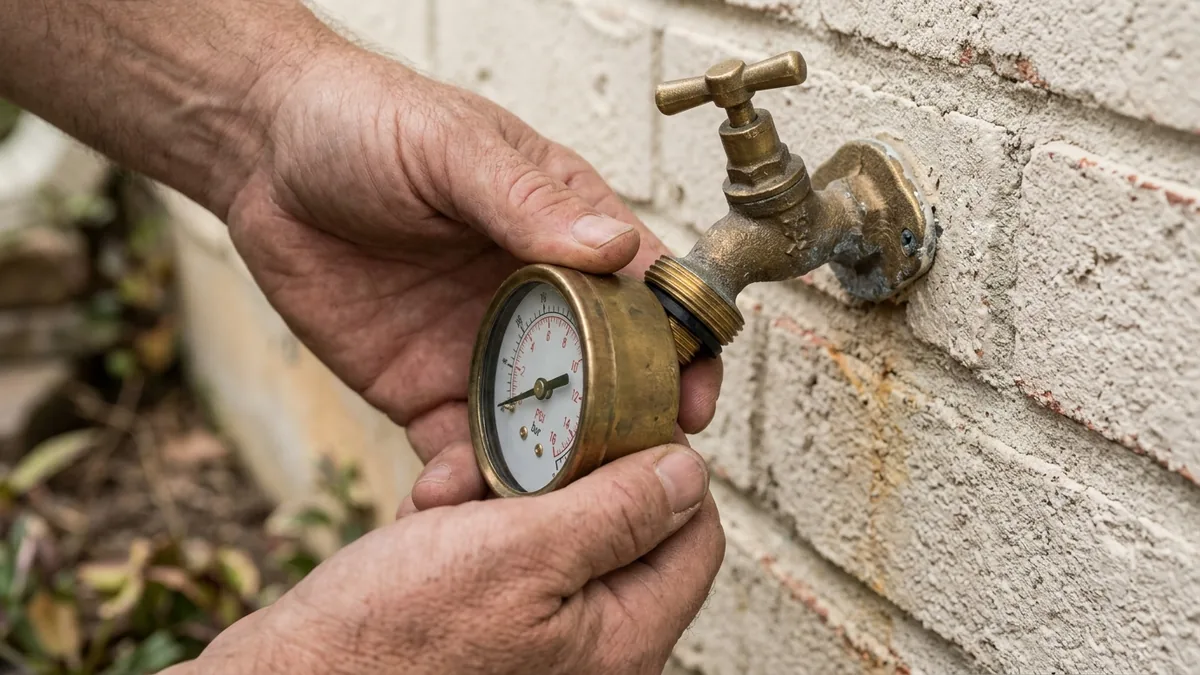
A cheap hose-thread pressure gauge helps. With every faucet off, screw it onto a spigot, open it and read the number, morning and evening. A number that sags at busy times points to the supply. A steady number with weak fixtures points to something inside the house.
What normal water pressure looks like↑ Contents
The U.S. Department of Energy recommends keeping system pressure between 20 and 80 psi. Below that range, efficient faucets and showerheads stop working the way they were designed to. Above it, fixtures use more water than their rating, and pipes, valves and appliances take a beating.
The top of that range is also where plumbing codes step in. As the Pacific Northwest National Laboratory’s building science guide notes, most plumbing codes require a pressure reducing valve when the supply pressure exceeds 80 psi. That is why so many houses have a PRV near the main shutoff, and why that valve is a common suspect when the whole house goes weak.
A healthy gauge reading can still come with a miserable shower. Pressure is only half the story; flow drops whenever pipes, valves or fixtures are partly blocked.
8 fixes for low water pressure, in order↑ Contents
Go in order. The first two cost almost nothing and solve most single-fixture complaints.
-
Clean the aerator and showerhead with vinegar
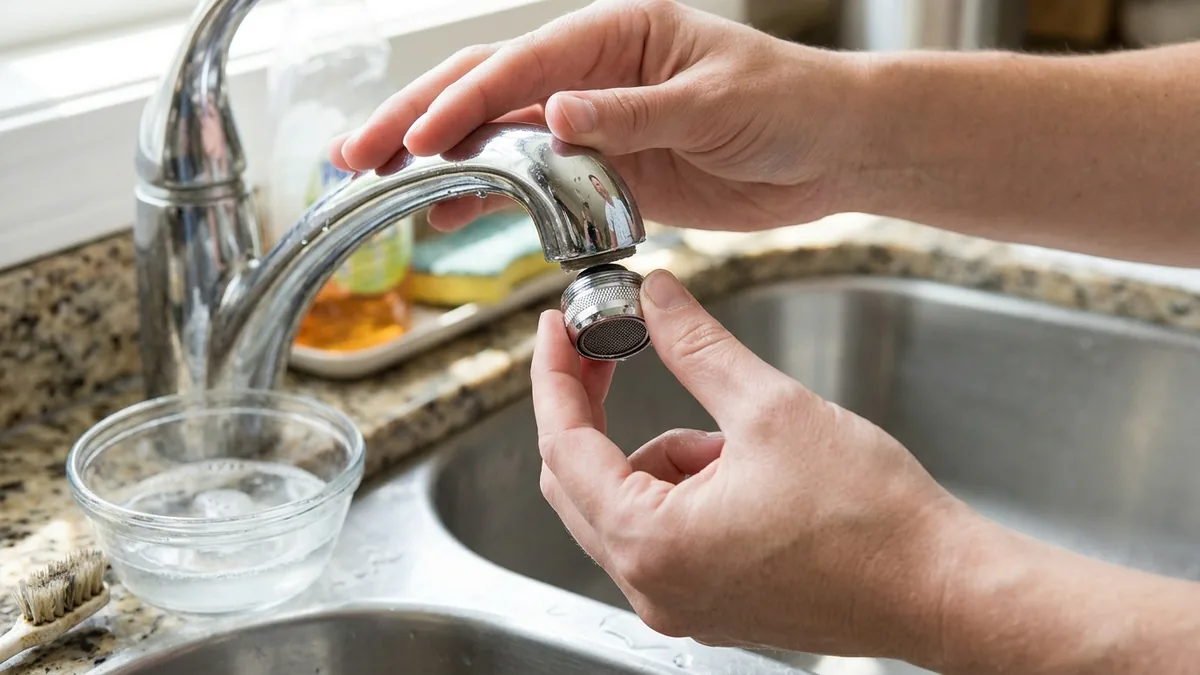
Hard water leaves mineral scale exactly where water exits: the aerator screen and the showerhead nozzles. After work on the water main, sand and pipe scale can also lodge in the screen overnight.
Unscrew the aerator from the faucet tip by hand, or with pliers wrapped in a rag so you don’t scratch the finish. Rinse out loose grit, soak the parts in white vinegar for an hour or more, scrub with an old toothbrush and rinse. For a showerhead, tie a plastic bag of vinegar over it with a rubber band so the face is submerged, leave it overnight, then rub the rubber nozzles to push out the loosened scale.
Never mix vinegar with bleach-based cleaners; together they release chlorine gas. While the aerator is off, run the faucet for a few seconds. If the flow is strong without it, the aerator was the problem, and a new one costs a few dollars.
-
Check for a flow restrictor
Federal rules cap new showerheads at 2.5 gallons per minute and kitchen and bathroom faucets at 2.2 gpm, according to the Department of Energy. Many models go lower, and they get there with a small plastic disk called a flow restrictor, usually sitting just inside the inlet of the showerhead or in the aerator.
A restrictor that is clogged with debris will choke the flow far below its rating. Pull it out carefully, rinse it, and put it back. If the house simply has marginal pressure, a showerhead designed for low-pressure homes is a better route than removing the restrictor.
-
Open the main shutoff and meter valve all the way
This one catches people constantly: the main gets shut for a repair, reopened most of the way, and the house runs at reduced flow for years. Find the main shutoff where the supply pipe enters the house. A gate valve with a round wheel should be turned counterclockwise until it stops. A ball valve with a lever is fully open when the handle runs parallel to the pipe.
There is often a second valve at the meter, in the box near the street. If the meter valve is in a pit or has a special nut, call the utility rather than forcing it.
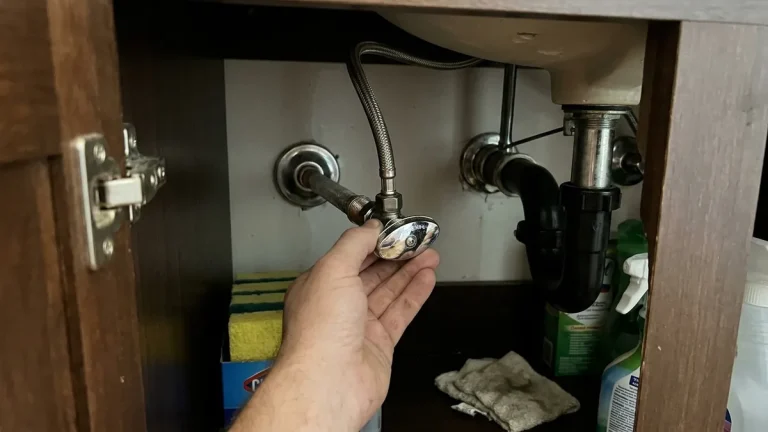
Also check the small shutoff valves under the sink or behind the toilet if only one fixture is weak.
-
Check the pressure reducing valve
A PRV is a bell-shaped brass valve, usually right after the main shutoff, with a bolt and locknut on top. Inside is a spring and a diaphragm that hold the house at a set pressure. A worn one can drop the whole house to a dribble or make pressure swing.
The basic adjustment is simple: loosen the locknut, turn the adjusting screw clockwise to raise pressure or counterclockwise to lower it, a quarter turn at a time, and check the gauge after each change. Stay below 80 psi. If a few turns change nothing, or the pressure creeps back down within days, the valve is worn and needs replacing.
Replacing a PRV means cutting into the main line, often soldering, and sometimes adding a thermal expansion tank. That is plumber work. If you are not sure whether the PRV is the problem, a plumber can test pressure on both sides of it in a few minutes.
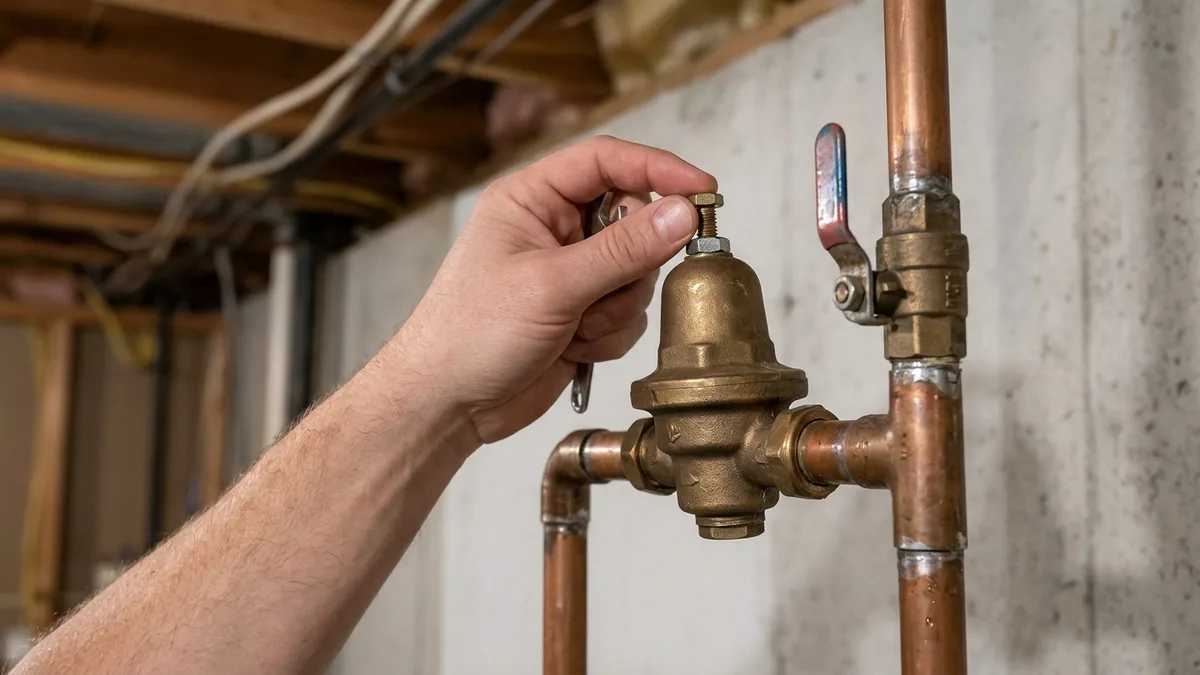
Check that the main shutoff is fully open, then look at the pressure reducing valve next to it. -
Look at the water softener and filters
A loaded whole-house sediment filter restricts every fixture. Shut the valves on either side, release the pressure, unscrew the housing and look. A brown, caked cartridge needs replacing.
Softeners can do the same thing when the resin bed fouls or the control valve sticks. The quick test is the bypass valve on the softener head: switch it to bypass and run a faucet. If pressure jumps back to normal, the softener is the restriction and needs service.
-
Flush the water heater for hot-side-only problems
When the cold side is fine and the hot side is weak everywhere, sediment in the tank or scale at the hot outlet is the usual culprit. First confirm the cold inlet valve on top of the heater is fully open. Then consider flushing the tank, a routine maintenance job covered step by step in the PNNL water heater flushing guide.
The outline: read your owner’s manual first, turn off the gas or the breakers, close the cold inlet, open a hot faucet, run a garden hose from the drain valve to a floor drain or outside, and drain until the water runs clear. Refill completely, with air sputtering out of the open faucet, before restoring power or gas.
Scald and gas caution: the water coming out of the tank is hot enough to burn. Electric heaters must stay switched off until the tank is full again, or the elements can be damaged in seconds. On gas heaters, follow the manufacturer’s instructions for the gas valve and pilot. If you smell gas at any point, leave the house and call the gas utility from outside.
-
Rule out a hidden leak with the meter test
A hidden leak steals water before it reaches your faucets. The EPA’s WaterSense program recommends a simple check:
- Make sure no water is being used inside or out: no dishwasher, no ice maker filling, no irrigation.
- Write down the meter reading, or note the position of the small leak indicator dial.
- Wait two hours without using any water.
- Read the meter again. If it moved, you have a leak somewhere.
Then close the main shutoff and watch the meter. Still moving means the leak is between the meter and the house; stopped means it is inside, often a toilet flapper.
-
Consider old galvanized pipes
Houses plumbed before roughly the 1960s often have galvanized steel supply lines. The zinc coating wears away, the steel rusts from the inside, and the opening slowly closes up like a clogged artery. Signs: pressure that has dropped gradually over years, brownish water after the house sits unused, and gray threaded pipe that a magnet sticks to.
No chemical or flushing method clears corroded galvanized pipe for long. The real fix is replacing it with copper or PEX, either the whole system or the worst sections near the main. That is a job for a licensed plumber, usually with a permit.
Low water pressure in the shower or kitchen faucet↑ Contents
Low water pressure in the shower
Clean the showerhead first. If the head is clean and the flow is still weak, take it off and run the bare shower arm. Strong flow from the arm means the head is the restriction, and a new one solves it. Weak flow from the arm points into the wall: most modern shower valves have a pressure-balancing cartridge that can clog with debris or scale, especially if the house just had work on the main. Replacing it is a reasonable DIY job if you can match the part to the valve brand.
Low water pressure in the kitchen faucet
Kitchen faucets catch every bit of grit in the line. Clean the aerator, and on a pull-down faucet unscrew the spray head from the hose and check the small screen at its base. Next, look at the two supply valves under the sink and open both fully. If one side, hot or cold, is weak only at this faucet, the cartridge is the likely cause. Shut the supply valves, remove the handle, pull the cartridge, and rinse any debris out of the faucet body before putting it back or replacing it.
How to increase water pressure once the clogs are gone
If the gauge shows the supply itself is low and everything is clean and open, there are two real options. When there is a PRV, a plumber can raise its setting within the safe range. When the street pressure is simply low, a booster pump with a small pressure tank is the standard answer, and that installation belongs to a plumber.
When to call a plumber↑ Contents
Do the free checks first, then call a licensed plumber if any of these apply:
- The PRV does not respond to adjustment, or pressure swings up and down.
- The meter test shows a leak and you cannot find it at a toilet or faucet.
- The house has galvanized supply pipe and pressure keeps dropping year after year.
- Pressure is low on the hot side even after flushing, or the heater rumbles, leaks or is past its rated life.
- The gauge reads above 80 psi with no PRV, or the PRV is set too high.
- You see rust-colored water, a wet spot in the yard, or water stains on a ceiling.
Bring your gauge readings and note which fixtures are weak. That turns a long troubleshooting visit into a short repair.
Low water pressure: FAQ↑ Contents
Why is my water pressure suddenly low in the whole house?
A sudden drop everywhere usually comes from outside the fixtures: utility work, a main break, hydrant flushing, a valve that was just closed for a repair, or a pressure reducing valve that has failed. Ask a neighbor first. If they are fine, check your main shutoff and PRV, then do the meter test for a leak.
Why is my water pressure low in only one faucet?
Because the restriction is in that faucet. Clean the aerator, check the supply valves under the sink, and if that does not fix it, look at the cartridge. Debris knocked loose after plumbing work often ends up in exactly one fixture.
Why is only my hot water pressure low?
When cold water is strong and hot water is weak at every tap, the water heater is the common point. Sediment in the tank, scale at the outlet or a partly closed valve at the heater are the usual causes. Flushing the tank helps in many cases; an old tank full of scale may need replacing.
How do I increase water pressure in my house?
Clear the clogs first: aerators, showerheads, filters. Make sure the main and meter valves are fully open. If you have a PRV, it can be adjusted up, staying below 80 psi. If the supply from the street is truly low, a plumber can install a booster pump.
Is low water pressure a sign of a leak?
It can be. A large hidden leak diverts water before it reaches your faucets. Turn everything off, read the meter, and check it again two hours later. Any movement means water is going somewhere.
Low water pressure almost always has a findable cause. Work out whether it is one fixture, the hot side, the whole house or the street, then fix from the cheapest end: vinegar, open valves, clean filters, a flushed heater. A meter leak, a PRV that will not hold or old galvanized pipe is the point to call a plumber.
Sources: U.S. Department of Energy, faucets and showerheads best practices, PNNL Building America Solution Center, service water pressure, U.S. EPA WaterSense Fix a Leak Week, PNNL guide to flushing a water heater tank.