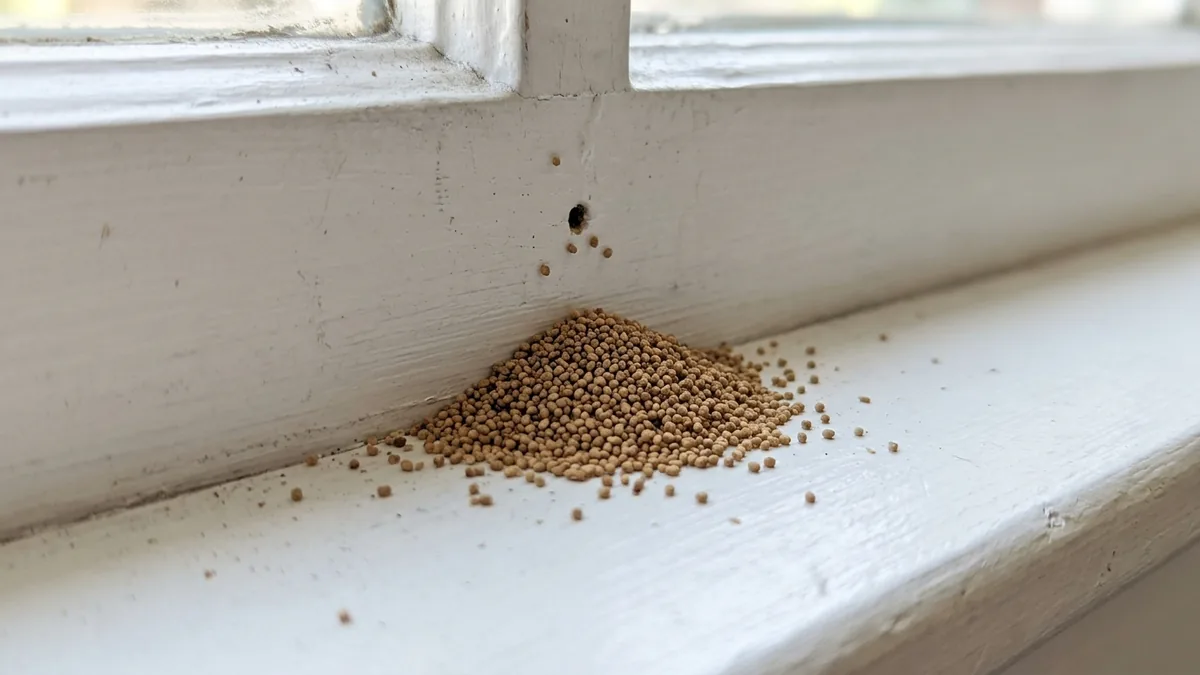
Termite droppings usually show up as a small pile of what looks like sand or coffee grounds on a windowsill, a baseboard or the floor under a piece of furniture, and most people sweep them up without a second thought. That pile is often the first visible sign of drywood termites living inside the wood above it. This guide shows you how to recognize real termite pellets, how to tell them apart from carpenter ant sawdust and other look-alikes, and exactly what to do in the first few days after you find them.
Termite droppings, called frass, are tiny hard pellets with six flat sides and rounded ends, colored anywhere from light tan to almost black. They pile up under pinhole-sized “kick-out” holes in wood. Only drywood termites leave them. Photograph the pile, sweep it up, watch for fresh pellets, skip the bug spray, and book a licensed termite inspection.
What termite droppings look like↑ Contents
Drywood termites live entirely inside the wood they eat. They never need contact with soil, so a colony can sit inside a window frame, a door jamb, a roof rafter or an antique dresser for years. To keep their tunnels clean, the workers chew tiny round openings to the surface and push their waste out. Those openings are called kick-out holes, and the waste is the frass you find below them.
Up close, the pellets have a very specific shape. The University of Florida IFAS Extension describes them as six-sided and barrel-shaped, light tan to almost black, and gritty when you roll them between your fingers. The color has nothing to do with the color of the wood being eaten, so dark pellets under a light pine trim board are normal.
- Size: each pellet is smaller than a grain of rice, closer to coarse sand. To the naked eye a pile reads as grit or dust.
- Shape: oblong, with six flat sides and ridges running lengthwise. A cheap 10x hand lens or your phone’s macro mode shows the facets clearly.
- Uniformity: every pellet is nearly the same size. Mixed dust and debris is never this consistent.
- Texture: hard and dry. They do not smear or crumble into powder when pressed.
- Location: a neat cone-shaped pile on a horizontal surface, directly below one or more holes about 1 to 2 mm across.
The pile shape depends on height. Mississippi State University Extension notes that small, uniform, six-sided pellets piling up on floors or countertops point to drywood termites. When the kick-out hole sits just a few inches above a sill, you get a tidy mound. When it is up near the ceiling, pellets bounce and scatter, and the scatter is easy to mistake for ordinary dust.
Termite frass vs. sawdust and other look-alikes↑ Contents
Plenty of things leave small piles near wood. The fastest way to sort them out is to look at the shape of the individual particles, not the pile. Put a few grains on a white index card and look closely.
- Drywood termite pelletsHard, uniform, six-sided pellets with rounded ends. Feels like fine gravel. Collects under tiny round holes. This is the one that needs a termite inspection.
- Carpenter ant frassLooks like coarse sawdust or pencil shavings: fibrous, irregular, soft. Often mixed with dead ant parts and bits of insulation. Carpenter ants do not eat wood; they chew it out to make nest galleries and dump the debris. They favor damp or previously damaged wood, so the pile often sits near a leak, a sweating pipe or a rotted sill.
- Powderpost and other wood-boring beetlesFine, flour-like powder that sifts out of small, perfectly round exit holes. It feels soft, not gritty, and has no distinct pellet shape you can count.
- Dampwood termite pelletsAlso pellets, but larger and rounded at both ends like a tiny football, without the clear lengthwise ridges, according to UC Statewide IPM. Dampwood termites need very wet wood.
If you are still unsure after a close look, save a sample. Tip a spoonful into a zip-top bag, label it with the date and the spot where you found it, and hand it to the inspector.
Why subterranean termites leave mud tubes, not pellets↑ Contents
The U.S. EPA lists the native subterranean termite as the most common termite across most of the country, with drywood and Formosan termites less common. That matters here, because subterranean termites almost never leave a pile of droppings for you to find.
Subterranean termites nest in the soil and dry out quickly in open air. To reach the wood in your house, they build pencil-width shelter tubes out of soil, chewed wood and their own waste, cemented with saliva. Inside the wood, they line their galleries with the same mud mix instead of pushing waste out. So the evidence looks like dirt, not sand.
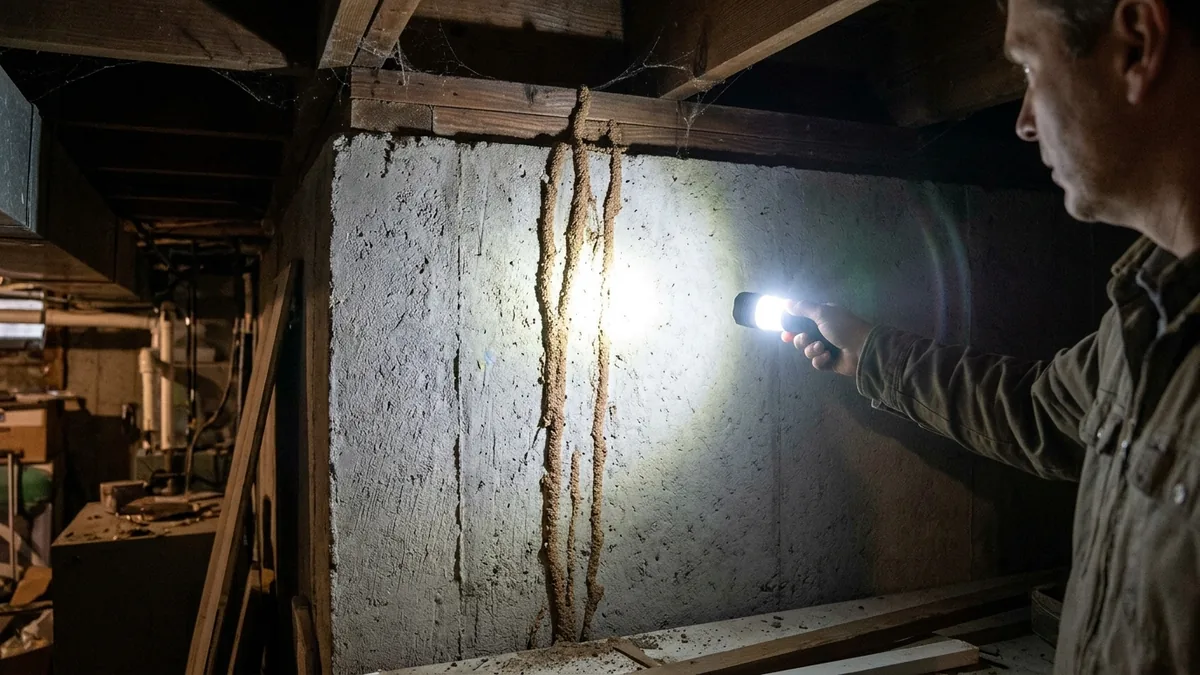
- Mud tubes running up the foundation wall, piers or plumbing, outside or in the crawl space.
- Wood that looks fine on the surface but has galleries packed with dried soil inside.
- Thin, sunken, winding lines under paint or wallpaper where termites ate the paper face of drywall.
Mississippi State Extension suggests a simple activity test: break off about 1 inch of a tube and check over the next few days. If termites rebuild it, the colony is active. Breaking tubes does not control the colony, it only tells you whether one is working there.
Correct identification changes the treatment. A soil-applied liquid barrier protects against subterranean termites but does nothing against drywood termites living up in the attic framing. UF/IFAS states plainly that soil termiticide treatments do not work against drywood termites. Tell your inspector exactly what you found and where.
Other termite signs to check right away↑ Contents
Once you have found pellets, spend 20 minutes with a flashlight and a flathead screwdriver checking the rest of the house. Drywood colonies are often spread out, and one pile rarely means one spot.
- Swarmers and discarded wingsWinged termites leave mature colonies to start new ones. Look for small piles of identical wings on sills, in spider webs and near light fixtures. Drywood swarms run from spring into late fall depending on species, and many native subterranean colonies swarm in spring. EPA’s quick check: termite wings are all about the same length and the antennae are straight, while flying ants have longer front wings, bent antennae and a pinched waist.
- Hollow-sounding woodTap trim, sills and exposed beams with the handle of the screwdriver. Damaged wood sounds papery and dull. EPA also suggests probing exposed wood with the blade to find soft spots.
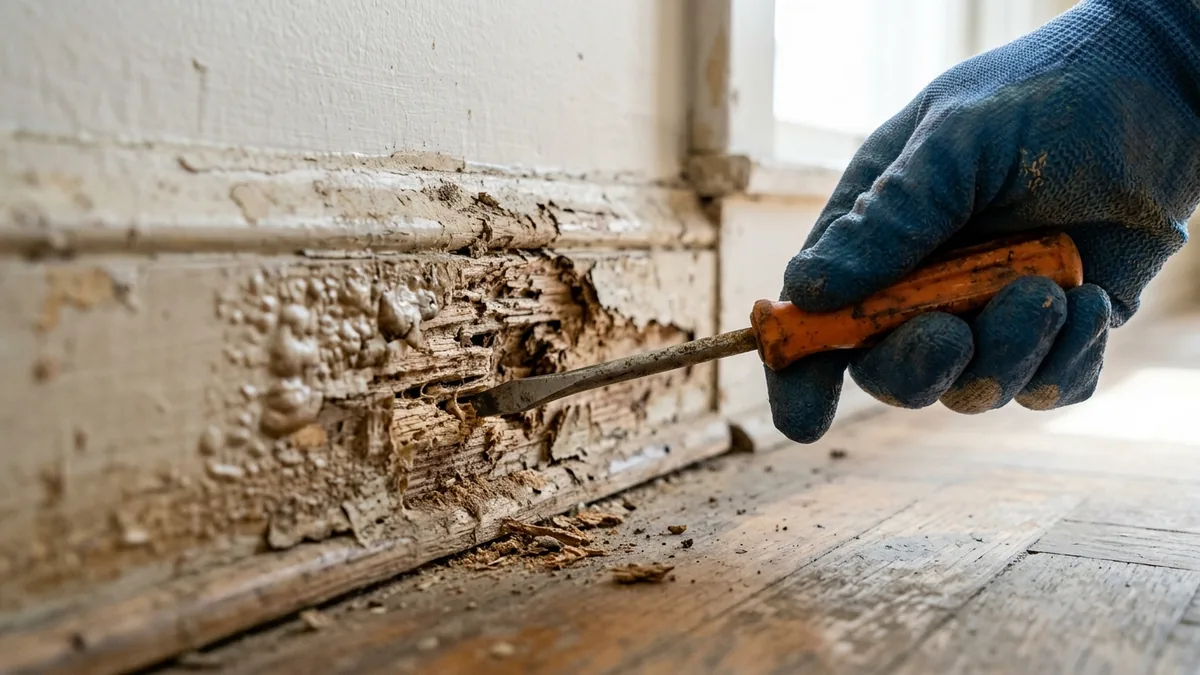
Damaged wood sounds hollow and gives way easily when you probe it with a screwdriver. - Blistered or bubbling paintPaint that ripples or looks water-damaged on dry wood can mean termites have eaten right up to the surface. UF/IFAS counts surface blistering as a sign of an advanced drywood infestation.
- Mud tubesCheck the foundation, crawl space, garage walls and around pipes where they enter the slab. Any tube points to subterranean termites, a separate problem from the pellets.
Found frass? What to do in the next few days↑ Contents
Termites work slowly. A colony that produced this pile has likely been there for years, so take a few days to collect good evidence.
-
Photograph everything first
Before you touch the pile, take wide shots that show the location and close-ups with a coin or a ruler for scale. Get the kick-out hole in frame if you can see it. These photos help the inspector and give you a baseline for later.
-
Bag a sample
Scoop a teaspoon of pellets into a sealed bag with the date and location written on it. A physical sample settles the “termites or ants?” question faster than any photo.
-
Sweep up, then watch for fresh pellets
Clean the area completely. Lay a sheet of white paper or a strip of painter’s tape on the surface below the hole, then check every day for a week. UC Statewide IPM recommends this exact test, because pellets alone cannot tell you whether an infestation is still active. New pellets after cleanup usually mean live termites, though UC also notes that building vibration can shake old pellets loose.
-
Do not spray
Store-bought bug spray kills the few termites it touches and leaves the colony inside the wood untouched. It can also push activity to a new spot and make the infestation harder to locate. The EPA warns that products which only claim to kill termites do not protect a structure, and UC IPM says home-use products are not effective for drywood termites.
Leave the kick-out holes open, too. Filling them with caulk or wood filler hides the best evidence the inspector has.
-
Call a licensed pest professional
Book an inspection with a termite company licensed by your state. The EPA advises asking to see the license and a copy of the product label for anything they plan to apply. Get two or three opinions on a large job, and ask each inspector whether they found drywood termites, subterranean termites or both, and how far the activity extends.
How pros treat termites↑ Contents
Treatment depends on the species and how widespread the colony is. Here is what each option means, so the inspector’s proposal makes sense.
Fumigation (tenting)
For drywood termites spread through several parts of a house, whole-structure fumigation is the standard fix. The house is wrapped in tarps and filled with a gas, most often sulfuryl fluoride. UF/IFAS puts the exposure at roughly 6 to 18 hours, and UC IPM notes that occupants, pets and plants leave for several days while the structure is treated and aired out, with gas pilot lights shut off. It reaches hidden colonies and leaves no residue, but it also leaves no lasting protection, so reinfestation is possible later.
Localized treatments
When the colony is confined to one accessible area, a licensed applicator can inject liquids, dusts or foams directly into the galleries, or replace the damaged board. Non-chemical spot options include heat, freezing with liquid nitrogen, electrocution and microwaves. UC IPM rates the efficacy of several of these as highly variable and points out that whole-structure treatments are more likely to catch hidden colonies. Whole-house heat treatment is another option: every piece of wood has to reach at least 120°F and stay there for at least 33 minutes.
Baits
Bait stations target subterranean termites. Workers feed on a cellulose bait laced with a slow-acting insecticide and carry it back to the colony. The EPA notes that baits can reduce the overall amount of insecticide used. They take months to work and need regular monitoring.
Liquid soil barriers
The most common treatment for subterranean termites is a termiticide applied to the soil around and under the foundation, creating a treated zone the termites must cross. The EPA cautions that a poorly applied barrier can contaminate the home and nearby drinking water wells, which is one more reason this belongs with a licensed professional.
Pesticide safety: many termiticides are highly toxic. Only products labeled for termite control and structural protection should be used, always at label rates. Ask the applicator when it is safe to return to the house and to let pets back in. For questions about a specific product, the National Pesticide Information Center answers calls at 1-800-858-7378.
Prevention that actually helps↑ Contents
No house is termite-proof, but these habits cut the odds and help you catch a colony while it is still small.
- Inspect old wood before it comes inside. Antiques, reclaimed mantels, salvaged doors and wooden souvenirs are a classic way drywood termites enter a home. Look for holes and pellets before you buy.
- Seal and paint exposed wood. UF/IFAS recommends caulking small cracks and joints and keeping wood painted, since swarmers enter through tiny gaps in bare wood.
- Screen attic and crawl space vents with 20-mesh screening, per UF/IFAS.
- Keep soil dry at the foundation. The EPA lists grading, clean gutters and working downspouts as basic subterranean termite prevention.
- Break wood-to-soil contact. Keep firewood, lumber and mulch piles away from the house, and keep shrubs trimmed back from siding.
- Fix leaks promptly. Damp wood draws subterranean termites and carpenter ants alike.
- Schedule an annual inspection if you live in termite country. A clean report one year is not a guarantee, but yearly checks catch problems early.
Termite droppings: FAQ↑ Contents
What do termite droppings look like?
Drywood termite droppings look like tiny grains of sand or coffee grounds. Under magnification each pellet is oblong with six flat sides and rounded ends. They range from light tan to almost black and collect in small piles under pinhole-sized kick-out holes in wood.
Does finding termite droppings mean I have an active infestation?
Not always. Old pellets can sit in a wall for years and shake loose from vibration. Sweep the area, lay white paper under the spot and check daily for about a week. Fresh pellets usually mean termites are still active, and either way a licensed inspector should take a look.
How can I tell termite frass from sawdust?
Termite frass is hard, uniform, six-sided pellets that feel gritty. Sawdust from carpenter ants is fibrous and irregular, like pencil shavings, and often includes dead ant parts. Powder from wood-boring beetles is fine and flour-like.
Do subterranean termites leave droppings?
Not in visible piles. Subterranean termites use their waste, mixed with soil and saliva, to build mud tubes and line their tunnels. Their signs are mud tubes on the foundation, swarmers in spring and damaged wood packed with dried mud.
Are termite droppings harmful to touch or breathe?
Termite pellets are dry, digested wood. Fine dust of any kind can bother people with allergies or asthma, so wear gloves and sweep or vacuum rather than blowing the area out with compressed air.
Can I get rid of drywood termites myself?
Apart from throwing away an infested piece of furniture or replacing a small damaged board, no. University extension services do not recommend do-it-yourself drywood treatments, and home-use sprays do not reach the colony. Termiticides should be applied by a trained, licensed professional.
Termite droppings are small, but they are one of the clearest signs a homeowner can find. Six-sided pellets piled under tiny holes mean drywood termites; mud tubes mean subterranean termites; fibrous sawdust points to carpenter ants. Photograph the pile, sweep it, watch for fresh pellets, skip the spray and get a licensed inspection. Acting on that first pile usually means a smaller, cheaper treatment.
Sources: U.S. EPA, Termites: How to Identify and Control Them, UF/IFAS Extension, Drywood and Dampwood Termites, UC Statewide IPM, Pest Notes: Drywood Termites, Mississippi State University Extension, Signs of Termite Infestation.